Galliano at Zara: When the signal and the system contradict each other
Inditex's two-year contract with John Galliano separates aesthetic direction from production control and tests whether a designer's name alone can shift how consumers value a system that hasn't changed.
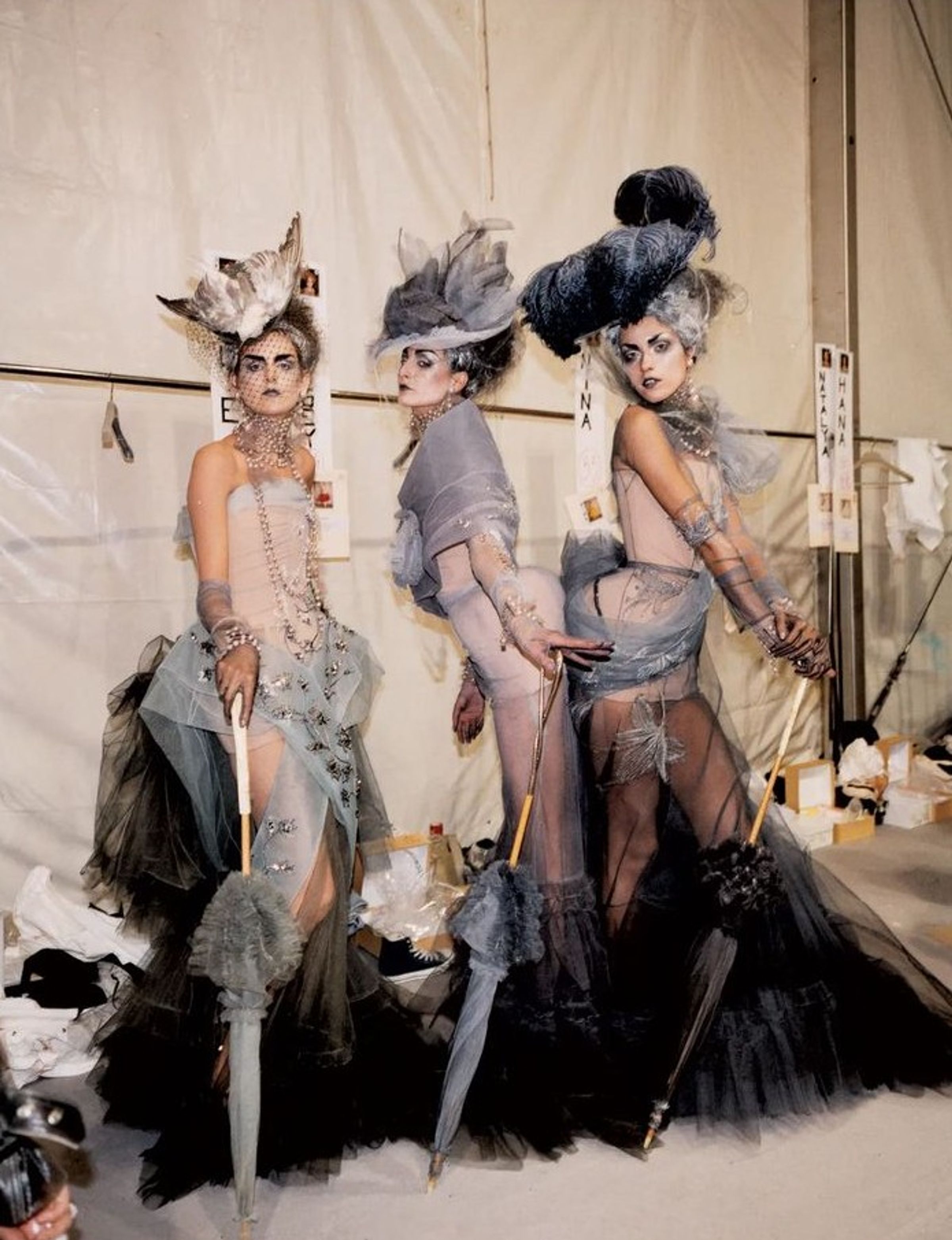
In March 2026, Zara announced a two-year partnership with John Galliano defined by an unusual structure: instead of designing collections from scratch, he will work from the brand’s archive, deconstructing and reconfiguring past-season garments into new seasonal expressions, released twice yearly from September 2026. In preparation, he and his team have spent months in an atelier outside Paris building toiles and studying proportion within the constraints of existing garments.
The collaboration has been received as a cultural event, marking a couturier’s entry into fast fashion. This approach involves Inditex purchasing a specific commercial instrument aimed at a particular consumer segment, and its effectiveness depends on whether aesthetic direction, separated from production control, can produce the promised shift in perception.
Inditex's portfolio problem
Inditex already owns brands occupying more considered territory: Massimo Dutti positions itself as premium, classic, and materially superior to Zara, with price points roughly two to three times higher on comparable categories. Within the broader market, COS and & Other Stories, owned by H&M Group but occupying the same competitive space, offer the design-led, elevated basics that Zara's Atelier line aspires to replicate. Zara's Studio and Atelier collections, with outerwear priced around €400 and campaigns shot by Paolo Roversi, have tested premium positioning for several seasons.
In this context, the Galliano collaboration serves a distinct strategic purpose by targeting the much larger Zara consumer who has not yet decided to spend more for superior fabric and quieter design, unlike Massimo Dutti’s audience. In FY2025, Zara (including Zara Home and Lefties) generated €28 billion in revenue, approximately 70% of Inditex's total €39.9 billion, while Massimo Dutti's revenues remain roughly one-tenth of that. By focusing on perception, the collaboration addresses the commercial centre of gravity: Zara, whose brand positioning defines the broader market’s view of the company.
The portfolio architecture clarifies why the investment prioritizes Zara over Massimo Dutti: the latter’s consumers have already migrated away from Zara’s price points and product proposition. Closing the revenue ratio by growing Massimo Dutti upward would require capturing segments already served by established premium players or moving Zara consumers into a higher-priced tier, both slower and structurally more difficult than shifting perception among consumers already shopping at Zara. The Galliano collaboration thus acts as a lower-friction instrument for achieving higher-value outcomes.
The broader portfolio architecture reinforces this logic. Between October 2024 and the end of FY2025, Inditex closed over 100 stores across its brands while expanding Lefties, its budget chain, to 215 locations with 17% year-on-year revenue growth, absorbing price-sensitive demand at the bottom of the market and competing with Shein and Primark. By contrast, the Galliano partnership elevates aspiration at the top, where Zara’s position between these two poles captures the largest revenue volume, and enhancing perception at this tier without losing existing consumers is the operation the collaboration is designed to perform.
The aspirational buyer's condition
The timing of the announcement reflects a specific consumer condition, as between 2023 and 2025 approximately 80% of luxury market growth came from price increases rather than volume gains, according to Bain & Company and Altagamma's 2025 Luxury Market Study. Over the same period, the global luxury consumer base contracted from roughly 400 million to approximately 340 million, while new customer acquisition declined by 5% between 2024 and 2025.
This contraction has not been evenly distributed across consumer segments. Luxury's core clientele continued purchasing through the downturn, while much of the contraction appears in the aspirational segment. These consumers previously entered luxury through entry-level accessories, seasonal sales, or diffusion lines, and have been progressively priced out as brands pursued what Bain's Joëlle de Montgolfier described as "elevation," a strategy that, in practice, amounted to sustained price increases across categories.
Despite this displacement, the aspirational segment has not abandoned the desire for status-carrying products. According to McKinsey and Business of Fashion's State of Fashion 2026 report, accessible luxury is rebounding because brands in that tier are engaging consumers trading down from higher price points and reactivating lapsed clients, while also attracting value-conscious Gen Z buyers entering the category for the first time. In the United States, 85% of survey respondents report using resale platforms to explore aspirational brands, reinforcing the persistence of demand even as budgets for traditional luxury compress.
Zara's intervention targets this compression by occupying the gap into which the aspirational buyer has been pushed. Although pricing for the September 2026 drop has not been confirmed, industry coverage has consistently framed the collaboration in terms of pricing power rather than accessibility. Zara's Atelier line already tests the €400 threshold, and the Galliano capsule will sit above standard Zara while remaining structurally below the entry price points from which these consumers have been displaced. This positioning allows Zara to offer a premium tier that remains within reach, and the use of a named designer rather than an anonymous Atelier label makes that shift clear to the specific consumer while masking the unchanged fast-fashion mechanics behind the product.
H&M’s Collaboration Model vs. Zara’s Strategic Approach
H&M has followed a two-decade history of designer collaborations, beginning with Karl Lagerfeld in 2004, structured around limited capsules produced by a named designer that sell out within hours generating brief media attention that fades before the next quarterly cycle. Collaborations with Balmain, Versace, Glenn Martens, and Stella McCartney have reproduced this pattern, although the novelty diminishes with each iteration.
H&M's financial trajectory reinforces that these bursts do not alter the brand's baseline perception: in FY2024, net sales declined slightly to SEK 234 billion from SEK 236 billion the prior year, even as operating profit improved to SEK 17.3 billion through cost controls. The collaborations create short-lived cultural moments while the commercial identity remains anchored to H&M’s everyday price-to-trend proposition.
Zara’s arrangement with Galliano establishes a contrasting strategy. The two-year contract with biannual drops ensures continuity and avoids the short-lived spikes typical of event-driven capsules. Galliano operates using Zara’s existing materials and silhouettes, introducing adjustments within the brand’s established framework instead of applying an external luxury aesthetic that vanishes after the capsule sells out. The collaboration draws on a sequence of prior partnerships with Soshiotsuki, Ludovic de Saint Sernin, Samuel Ross, and Studio Nicholson, progressively shifting Zara from a clothing brand toward a fashion house capable of influencing trends.
Sustained consumer perception change is central to this approach, and achieving that through collaboration alone, without altering Zara’s underlying production model, represents a novel precedent in fast fashion.
Translating Craft Expertise into Trend Signals
Galliano's historical work is built on technical foundations that cannot be replicated in Zara's supply chain. His signature bias-cut construction at Dior involved cutting fabric against the grain to create garments that follow the body's contours, a technique requiring extraordinary precision. For example, individual bias-cut slip dresses were assembled from nearly 30 pattern pieces, as documented in Sotheby's retrospective of his design methods. Before runway shows, his team heated models' skin so the fibres would cling more closely. The Maison Margiela Artisanal collections were built on similar principles, treating each garment as a unique object.
Zara's production model operates at scale, speed, and cost structures that prevent replication of this construction. The company's advantage lies in its integrated supply chain, rapid design-to-shelf cycles, and ability to produce large volumes at accessible price points. What Galliano contributes is aesthetic direction: silhouette references, proportion adjustments, print language, colour sensibility, and compositional logic recognizable from his work at Dior and Margiela. Some design codes translate without couture budgets: a bias-inspired cut in viscose still communicates his silhouette logic, even without silk or the 30-pattern-piece construction beneath it. Corset seaming and trompe-l'oeil prints function similarly, referencing visual outcomes Zara cannot reproduce.
This collaboration converts Galliano's craft expertise into trend signals within the constraints of Zara's production. Galliano defines the direction a garment takes, while construction remains with Zara's supply chain. This approach separates the narrative presented to consumers from the reality of fast-fashion production, exposing the structural limits of what translates when couture enters mass-market production.
Production velocity illustrates this divergence clearly. Brands that credibly occupy the accessible luxury tier manage releases alongside pricing. COS, owned by H&M Group, releases four main collections per year with a design-to-store timeline of four to six months, compared to fast-fashion brands that introduce hundreds of new items weekly, according to DoneGood and ApartStyle. Toteme, whose $150 million annual revenue was reported by the New York Times in 2024, operates a slow-fashion model with recurring styles and limited seasonal turnover. Zara's supply chain functions on entirely different principles: there is no structural cap or distribution limit for the Galliano capsule, so attaching a designer's name implies exclusivity that the system cannot enforce. Consequently, the signal purchased by consumers and the system producing it operate under incompatible premises.
Creative Vision vs. Production Constraints
Galliano's ten-year tenure at Maison Margiela demonstrates what full creative authority produces: when he arrived in 2014, the brand's annual revenues were approximately €100 million, according to market estimates reported by WWD, and by December 2024, revenues were approaching $500 million, with 23% sales growth in 2023 alone, according to OTB Group's annual results. That growth reflected Galliano's complete control over design, production standards, material selection, retail environment, and brand narrative, with every element integrated under a single creative vision.
At Zara, authority is distributed across separate functions: aesthetics to Galliano, production to the supply chain, and pricing and distribution to Inditex's commercial strategy. The collaboration will generate media attention and initial sales regardless of this integration. Achieving lasting consumer perception change requires assessing whether aesthetic direction alone, separated from control over materials, construction, and retail context, can change consumer perception instead of creating a temporary cultural spike.
Galliano's value at Margiela rested on garments embodying his vision from fibre to finished object. At Zara, his value will be tested by whether that vision can persist when separated from production, and whether consumers attribute enough of his influence to justify paying elevated prices.
Inditex's commercial logic is direct: higher price points on the existing supply chain improve margins without structural investment. The collaboration functions by enabling consumers to perceive the story of the designer without needing to evaluate the underlying production. Each consumer drawn into a premium fast fashion tier under this impression reinforces the system they believe they have graduated from. In this way, the collaboration extends fast fashion's reach into a previously excluded segment, adding to revenue, consumer base and systemic impact, while the narrative implies an upward trajectory that does not actually exist, keeping the system’s expansion into new consumer segments largely imperceptible.
Sources↓
- Bain & Company / Altagamma, Luxury Market Study, 2025.
- McKinsey & Company / Business of Fashion, The State of Fashion 2026.
- Inditex, FY2025 Annual Results, March 2026.
- OTB Group, Annual Results, 2023 and 2024.
- H&M Group, Full-Year Report, FY2024.
- FashionUnited, "Zara confirms 'fashion house' strategy through collaboration with Ludovic de Saint Sernin," November 2025.
- WWD, "John Galliano to Revisit Zara Archives in Unconventional Collaboration," March 2026.
- Glossy, "Luxury Briefing: Zara bets on Galliano to up its pricing power," 2026.
- Altor, "Slow fashion — fast growth" (Toteme company profile), 2024.
- DoneGood / ApartStyle, COS brand sustainability and production model analysis, 2024–2025.